


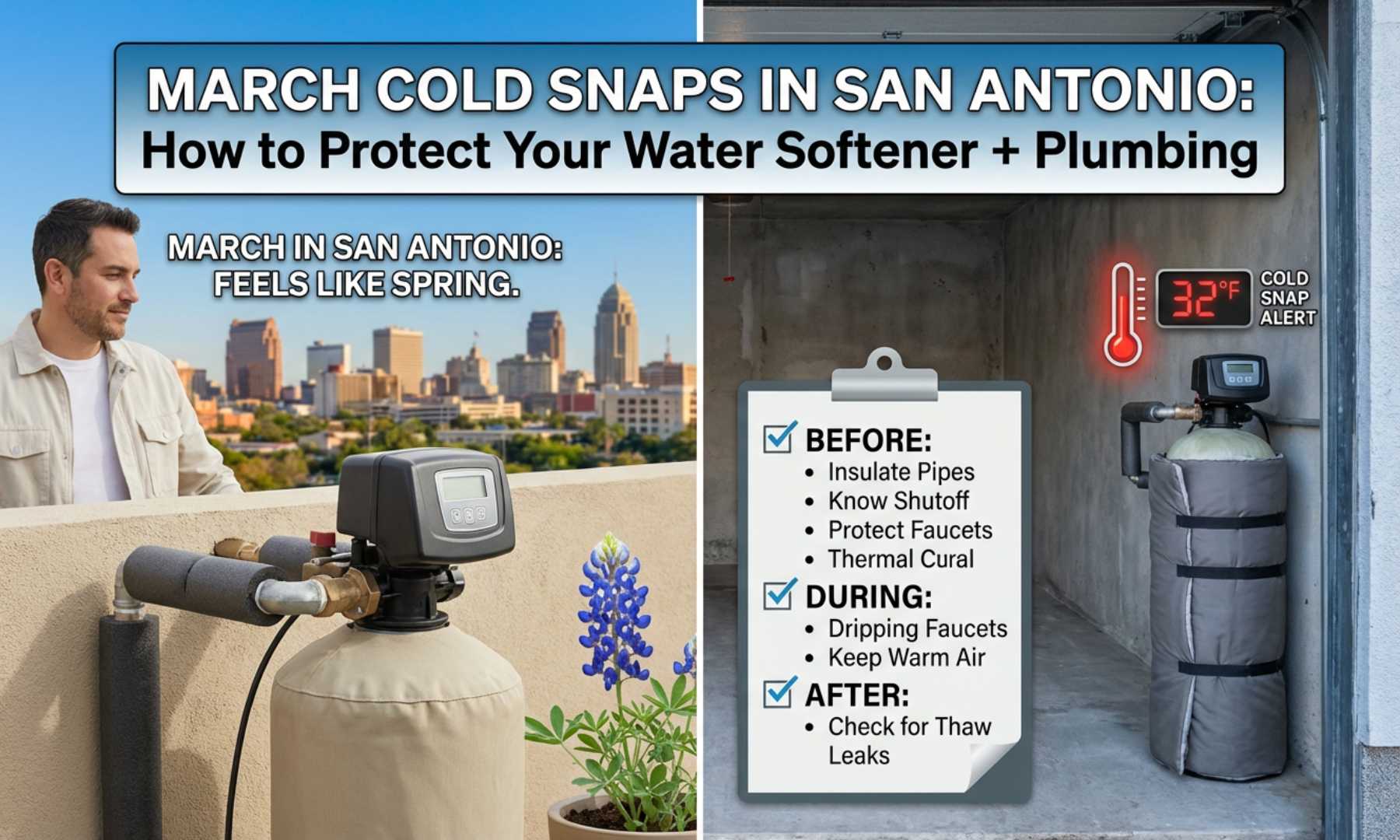
March Cold Snaps in San Antonio: How to Protect Your Water Softener + Plumbing
March in San Antonio feels like spring—but cold snaps can still show up and catch homeowners off guard. Historically, the average “last freeze” for San Antonio is around late February, but that doesn’t mean March is risk-free—especially in drafty garages, utility rooms, and outdoor installs.
If your water softener sits in a garage, shed, or outdoors, a single freezing night can crack fittings, damage the control head, and create leaks that don’t show up until everything thaws.
Below is a San Antonio-specific, step-by-step checklist to protect your water softener and plumbing before, during, and after freezing nights—updated for a March post (when people tend to relax their freeze routine).
Quick March reality check for San Antonio
-
March is meteorological spring, and South-Central Texas typically trends warmer—but weather swings are common (warm days + cooler nights, fronts, and fast changes).
-
Even when the city stays above freezing, unheated garages and exterior-wall plumbing can dip colder than you think—especially with wind and gaps around doors.
Rule of thumb: If the forecast shows 32°F or below (or a “freeze” headline), treat your garage softener and any exposed plumbing as vulnerable.
Why water softeners freeze (and what actually breaks)
A typical softener includes:
-
Resin tank (main cylinder)
-
Brine tank (salt tank)
-
Control valve/control head + small lines (brine line, drain line)
Freezing can:
-
Crack valves, elbows, fittings, and thin tubing
-
Cause leaks after thaw (the most common “surprise” failure)
-
Damage the control head (often the most expensive part)
-
Create slow drips → higher SAWS bills before you notice
If your unit is in an unheated garage, against an exterior wall, in a utility shed, or outdoors—take freeze prep seriously even in March.
Before the freeze (do this the day before)
1) Know your shutoff points (30 seconds that can save thousands)
-
Find your main shutoff and/or meter shutoff
-
Locate the softener’s bypass valve (usually near the control head)
SAWS guidance also emphasizes practical prep like sealing cold-air entry points, insulating exposed pipes, and opening sink cabinets to circulate warmer air around plumbing.
2) If your softener is in a cold spot, insulate + block wind
-
Wrap exposed pipes near the unit with foam pipe insulation
-
Insulate visible metal fittings and any exposed tubing
-
Seal drafts: garage door corners, wall penetrations, utility line holes
Cold wind speeds freezing—blocking airflow matters as much as insulation.
3) Protect outdoor spigots connected to the same line
-
Disconnect hoses
-
Cover outdoor faucets
-
If applicable, shut off and drain sprinkler lines
(This is still one of the most common “we forgot” items—even late in the season.)
4) Decide: keep running vs. bypass (depends on location)
If your softener is inside conditioned space:
-
Usually safe to leave it running normally
If your softener is in an unheated garage / shed / outdoors:
-
Consider putting it in bypass overnight to reduce water sitting in vulnerable components
-
Avoid scheduling a regeneration cycle during the coldest window (more flow + drain line exposure)
If you’re not 100% sure how your bypass positions work, don’t guess—mispositioned valves can cause leaks or “no water” situations.
5) Dripping faucets: do it the smart way
Instead of dripping everything, many pros recommend focusing on the single faucet farthest from the meter so water moves through the longest run.
-
Pick the faucet farthest from where water enters the home
-
If it’s a single-handle faucet, set to lukewarm so both hot + cold lines move
-
Open cabinets under sinks on exterior walls to let warm air circulate
During the freeze night
Keep warm air around vulnerable plumbing
-
Garage/utility room: keep doors closed and maintain some heat if safe
-
Interior sinks on exterior walls: keep cabinet doors open
If water pressure drops or a faucet stops flowing
Check multiple faucets. A “no water” moment during a freeze is often a localized frozen pipe rather than a system-wide outage.
After the freeze: don’t declare victory until you check these
1) Look for “thaw leaks”
When pipes and fittings thaw, hairline cracks become leaks.
-
Check around the softener control head, bypass valve, and fittings
-
Inspect the brine line and drain line
-
Look for water staining or dampness around the base
2) Bring the system back gradually
If you used bypass:
-
Return to normal service slowly
-
Watch for drips for 10–15 minutes
-
Run a manual regen only if everything looks dry + stable
3) If you suspect a frozen pipe, warm it gradually
-
Use safe warm airflow (space heater at a safe distance, open cabinets, warm room air)
-
Avoid open flames
San Antonio’s most common “late-season” freeze mistakes
-
Assuming “it’s March” and skipping insulation
-
Covering outdoor faucets but ignoring garage/utility plumbing
-
Forgetting hoses attached to outdoor spigots
-
Not knowing the meter shutoff until water is spraying
-
Leaving an outdoor softener exposed without wind protection
When to call a pro
Call a plumber or water treatment tech if:
-
You see leaks at the control valve or bypass
-
The unit throws errors / gets stuck mid-cycle
-
Water pressure drops after thaw
-
Your softener is outdoors and you want a permanent freeze-resistant setup
Need help in San Antonio?
If your softener is in an unheated area—or you want to winter-proof it permanently—Simple Water Softeners (San Antonio, TX) can help you choose the safest setup and troubleshoot post-freeze issues.
Local FAQ (San Antonio)
Do I need to drip faucets in San Antonio in March?
If temps approach freezing and your plumbing is on exterior walls or in unheated spaces, yes—use the “farthest faucet” strategy and open cabinets for warm air circulation.
Will a water softener freeze in a San Antonio garage?
It can—especially near an exterior wall, exposed to drafts, or if the garage tracks outdoor temps.
What’s the safest one move if I’m worried about my softener freezing?
If it’s exposed (outdoors or a very cold garage), bypass it overnight, block wind/drafts, insulate nearby plumbing, and inspect carefully once temperatures rise.